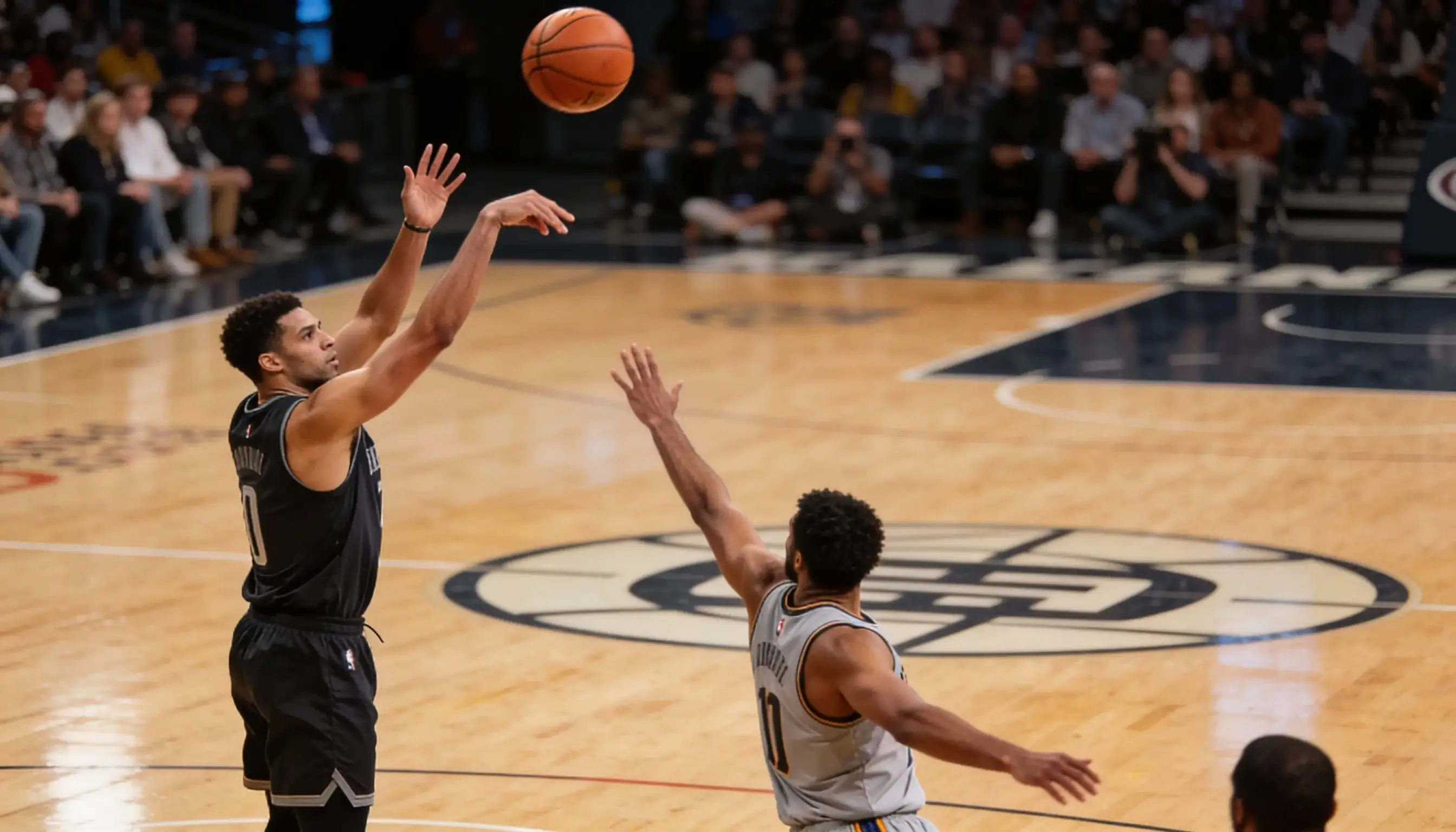
Basketball Player Props Strategy: Finding Value in Soft Lines
 Available in US

I built my first prop projection spreadsheet on a Sunday morning in February 2018, using a list of per-game averages I’d copied off Basketball Reference and a guess about how many minutes Kemba Walker would play that night. The bet I placed off it — Walker over 24.5 points — won, and I spent the next three years convinced I’d cracked something nobody else had. I had not. The spreadsheet was wrong about almost everything except minutes, and the bet won because the line was soft enough that even a bad projection beat it. That is the props market in a sentence.
Player props are the markets that ask you to bet on what an individual player will or won’t do — points, rebounds, assists, threes made, blocks, steals, double-doubles, and the various combinations of all of the above. They settle on the player’s box-score line. They do not care who wins the game. And they remain, as of the 2025–26 season, the single softest layer of the modern NBA betting menu for UK punters who are prepared to do the work.
The reason is structural and well-documented. Only around 2% of basketball wagers in 2024 were classified as player props, despite NBA fans wagering 3.7 times more than the average US bettor across all markets. The asymmetry between the depth of NBA fan interest and the shallow share of action going into props tells you the market is structurally underexposed, which means books face less pressure to set every line perfectly. The line you bet at 19:00 on a Tuesday may have been moved by exactly two punters since open.
This guide is the framework I actually use, not the marketing version. It walks through how props are priced, where the edges sit, what the 2025 integrity reforms changed, and how a simple projection model on a single player works in practice. I’ll be honest about what props can do for a UK punter, and equally honest about what they cannot.
Identifying Undervalued Metrics in Player Proposition Markets
There’s a basic asymmetry argument behind every prop strategy I’ve ever run, and it’s worth stating clearly because most punters skip past it. NBA fans wager about 3.7 times more than the average US bettor across the market — they are unusually engaged. But basketball player props in 2024 accounted for only about 2% of all wagers. Engagement is high; prop participation is low. That gap is the opportunity.
The simplest reading is that prop pricing is less battle-tested than game-line pricing. A book setting a moneyline on Lakers v Knicks at 18:00 GMT will see thousands of bets on that line by tip-off, and the line will adjust through the day towards the price that balances action. A book setting Luka Dončić’s points line at the same moment will see a tenth of that volume. The line either moves on a single sharp bettor or doesn’t move at all until late.
The second factor is data accessibility. Game-line modelling requires a team-level projection — point differential, pace, defensive rating — which the books model exquisitely well because the public-facing data is mature. Prop modelling requires player-level projections, which depend on minutes, usage rate, pace, opponent defensive scheme, and last-minute rotation news. Each of those variables compounds error. Books can model each one reasonably; the compounded line is wider, more often wrong, and harder for them to defend.
The third factor is integrity. Props on marginal players were the soft underbelly of the league’s integrity exposure, which is why the 2025 reforms following the Rozier and Billups indictments specifically targeted that segment. What remains in UK lobbies is the prop market on rotation players — starters and consistent bench contributors — where minutes are stable enough to model. That subset is structurally cleaner than the props market was 18 months ago, but it is also still softer than the equivalent game lines.
None of this guarantees you a profit. Soft markets reward work, not enthusiasm. The next section walks through the actual anatomy of a prop market, so you can see where in the pricing chain your own edge might sit.
Anatomy of a Prop Market
If you want to find a mispriced prop, you have to understand what the book did to price it correctly first. There are five inputs that go into a typical NBA points-prop line, and they multiply rather than add — meaning a small error in any one input compounds through the rest.
The first input is projected minutes. A starter on a healthy roster will play 32 to 36 minutes; a starter on a back-to-back will play 28 to 32; a starter on a rest day will be DNP-Coach’s Decision. The book starts with a season-average minutes baseline and adjusts for rotation news, injury status of teammates, and scheduling.
The second input is pace-adjusted per-minute production. A player who scores 24 points in 32 minutes is producing 0.75 points per minute. Multiply that per-minute rate by the team’s pace adjustment (pace divided by league average), and you have a pace-adjusted baseline. A high-pace game inflates points by 5–8% over the season average; a low-pace defensive game compresses by the same.
The third input is usage rate. Usage measures the percentage of team possessions a player “ends” — by shooting, getting fouled, or turning the ball over. A 30% usage player is shouldering nearly a third of his team’s offense. When a teammate is out, usage redistributes — a star whose usage typically sits at 28% might play at 33% when the second scorer is sidelined, which inflates points expectation by roughly 15% even before pace adjustments.
The fourth input is the opponent’s defensive context. Opponent defensive rating tells you points allowed per 100 possessions. A guard going against a team that allows 118 to opposing guards has a different projection than the same player against a top-five guard defence at 105. Books use position-versus-position defensive ratings, not just team rating, but the public-facing data is decent enough that a UK punter can replicate the rough math.
The fifth input is vig. The book sets the line — say, 24.5 points — and then prices over and under at decimal odds that build in the house margin. Standard prop pricing is roughly 1.83/1.83 on a clean two-sided line (combined implied probability 109%, or 9% hold), but you’ll see 1.91/1.75 or worse when the book is trying to discourage one side.
The reason props are heavily affected by live betting is that all five inputs are dynamic during the game. With live/in-play projected to reach roughly 75% of all US sports bets by 2025, props that look “settled” pre-match are actually trading through three quarters of in-game line movement. If a player’s minutes line up at 36 instead of the 32 the book projected pre-match, the live points-prop line shifts upward through the first half. Punters who can monitor minutes early can fade obvious overcorrections.
Core Prop Categories
Not every prop is the same prop. A points line behaves differently to a rebounds line, which behaves differently to a threes-made line, and a UK punter who builds a workflow that treats all props as a single category will get systematically outmaneuvered by the player who specialises by category.
Points props are the largest, most liquid prop category. For elite scorers, lines sit between 20.5 and 32.5 points; for rotation bench players, between 6.5 and 14.5; for high-minutes starters between 12.5 and 22.5. Points props are the easiest to model because the inputs (minutes, usage, pace, opponent) are stable. They are also the most heavily watched, which means the lines are sharper than rebounds or assists. A typical points-prop example: Luka Dončić over 28.5 points at decimal 1.83. The model question is whether Dončić’s projected minutes × per-minute scoring rate × pace adjustment × opponent defensive context produces a true projection above or below 28.5.
Rebounds props vary by position. Centres and power forwards trade between 7.5 and 13.5 rebounds; wings between 4.5 and 8.5; guards between 3.5 and 6.5. Rebounds are heavily influenced by the opponent’s shooting profile — a team that misses more shots produces more rebounding opportunities for the centre — which is a less obvious matchup factor than offensive defensive rating.
Assists props sit primarily on point guards and high-usage playmaking wings. Lines for elite passers — Trae Young, Tyrese Haliburton, Luka Dončić — sit at 8.5 to 12.5 assists; for combo guards between 4.5 and 7.5; for off-ball wings rarely above 3.5. Assists are highly sensitive to teammate scoring efficiency: a passer in a hot-shooting team racks up assists at a higher per-minute rate than the same passer when teammates are cold.
Threes-made props are a high-variance, high-volume category. Lines sit at 2.5 to 4.5 for shooters; occasionally as high as 5.5 for elite snipers. Threes have higher variance than any other counting category because each attempt is binary (in or out), and a small change in shot quality changes the count by one or two attempts.
Steals and blocks props are the lowest-volume, highest-variance counting categories. Lines sit at 0.5, 1.5, or occasionally 2.5. These are largely noise markets for the average punter and I generally don’t trade them.
Combo props — points plus rebounds, points plus assists, points plus rebounds plus assists (PRA) — combine the underlying inputs. They smooth out variance in any single category (a player can have a quiet rebounding night and still hit PRA via points), but they also stack hold across multiple market levels. PRA props are popular for that reason: they feel “safer” because the line absorbs single-category cold nights.
Double-double and triple-double props are all-or-nothing. The player either records 10+ in two (or three) categories or doesn’t. Most double-double props are priced at “Yes” decimal 2.00–2.80 with the “No” side as the favourite, reflecting the underlying probability. Triple-double props are heavily juiced towards “No” — typical “Yes” prices sit at 5.00 or longer.
First basket props are entertainment markets with high implied holds — typically 130–160% across the field — and structurally negative EV for the median punter. I include them because UK lobbies promote them heavily, not because I recommend them.
Five Frameworks for Spotting Prop Edges
Five frameworks have produced consistent edge for me across the last six seasons. None of them is novel. All of them require the punter to spot something the book’s model didn’t fully price. They’re listed in order of how often they actually show up in a typical betting week.
Framework one is the minutes flag. The single highest-signal pre-match read is when projected minutes diverge from season-average minutes for a known reason. A starter coming off a 36-minute night will play closer to 30 on the second leg of a back-to-back. A bench wing whose team’s starting guard is out will play 28 minutes instead of his usual 18. Books capture rotation news, but they sometimes lag by 30 minutes — particularly if the news drops between lobby update cycles. If you spot a minutes change before the line moves, the prop is mispriced.
Framework two is the pace mismatch. Two teams with different paces will produce different totals, but the per-player rate carries through. A Memphis-Indiana matchup at projected pace 102 will inflate every player prop on both rosters by 4–5% over the season average. A New York-Cleveland matchup at projected pace 95 compresses them. UK lobbies don’t always adjust prop lines for matchup-specific pace; the season-average baseline carries through, which leaves room to fade the overs in slow matchups and the unders in fast ones.
Framework three is back-to-back fatigue. The data here is well-established: second-leg-of-back-to-back teams score 3–5% less efficiently and shoot a meaningfully lower three-point percentage, with the effect concentrated in the starters who played the most minutes the previous night. A starter coming off 38 minutes the night before is a prop fade candidate; a starter who only played 28 the night before is less affected.
Framework four is matchup defensive context. A guard going against the top-five guard defence is a different bet than the same guard against a bottom-five guard defence. Books model team defensive rating; they don’t always model position-versus-position defensive rating. UK lobbies are particularly prone to this gap on rebounds props, where the matchup between a centre and the opposing centre’s offensive rebounding profile is a serious factor.
Framework five is the usage-spike opportunity. When a primary scorer is ruled out (typically 45 to 75 minutes before tip-off in the official injury report), team usage redistributes to the remaining starters. A team’s second scorer might see usage rise from 25% to 31% and project 18% more points; a third scorer’s usage might rise less but still produce a meaningful prop overlay. The window of opportunity is narrow — lines move within an hour — but the edge is large when the book hasn’t fully redistributed.
Alternate Lines and Bet Builders
Two related markets sit alongside the standard prop offer and deserve a quick mention even though each has its own dedicated piece.
Alternate lines on props are a ladder of priced points around the main line. If Dončić’s main points line is 28.5 at 1.83/1.83, the alternate ladder might run from 22.5 (1.20), 24.5 (1.40), 26.5 (1.55), 28.5 (1.83), 30.5 (2.20), 32.5 (2.85), 34.5 (3.80). The alt over at 32.5 (2.85) is selling you a more aggressive view of the same player; the alt under at 24.5 (1.40) is selling you a more conservative one. Alt-line pricing is rarely perfectly mathematically consistent across the ladder — books shade the points where they expect heavy action — and the rungs that are quietly mispriced are where punters who model their own distributions can find edge.
Bet builders (same-game parlays) let you combine multiple props from a single player or game into one ticket. The book accounts for some of the correlation between legs (a player going over points is positively correlated with going over PRA, for example) but rarely accounts for all of it. Builders that pair correlated props at less-than-correlation-adjusted prices are mathematically positive-EV; builders that pair uncorrelated props are mathematically negative because the multiplicative hold compounds across legs. Most casual builders sold to UK punters fall into the second category. The first category exists but requires careful screening.
Pitfalls in the UK Context
The 2025 integrity reforms changed the prop landscape for UK punters in ways that are worth understanding before you build any strategy around the market. The trigger was the FBI’s October 2025 indictments of Terry Rozier and Chauncey Billups, both involving gambling-related allegations. The NBA’s response was to ask sportsbook partners to limit props on marginal players.
Adam Silver was specific in his explanation to ESPN: “We’ve asked some of our partners to pull back some of the prop bets, especially when they’re on two-way players — guys who don’t have the same stake in the competition — where it’s too easy to manipulate something that seems small and inconsequential.” The downstream effect on UK lobbies was real. Two-way contract player props largely disappeared. End-of-bench props on rotation players with low minute counts were quietly thinned out. Player prop holds in some categories widened.
For a strategic UK prop punter in 2026, three things follow. First, the soft market on two-way and 11th-man unders that some sharp bettors had been grinding is gone — that part of the menu was the riskiest from an integrity standpoint and the books were happy to close it. Second, the remaining prop market on starting and rotation bench players is broadly intact, with the same modelling opportunities I described earlier. Third, props get pulled faster when news breaks. A star ruled out at 18:30 GMT might see his prop line vanish before 18:45; books are quicker to lift markets than to reset them, because the integrity exposure of getting it wrong is now higher than the revenue from keeping the line live.
The practical implication: build your workflow around major rotation players, not benchwarmers. The edge that remains is on minutes-stable, mid-to-high-usage players where the modelling work pays off. The edge that’s been removed is on volatility props that always had a slightly questionable smell. That’s a reasonable trade for the integrity of the market overall.
A Simple Projection Walk-Through
A working projection model doesn’t need to be elaborate. The one I run for a quick check before placing a points-prop bet fits on the back of a napkin, and that’s deliberate — anything more sophisticated needs more inputs than I can reliably get inside the window between rotation news and tip-off.
The structure: minutes × per-minute scoring × pace adjustment, then check against the line.
Take a hypothetical Luka Dončić points line at 28.5 for an upcoming game.
Step one is minutes. Dončić’s season average is 36.2 minutes. Is anything different tonight? He played 38 last game, full rest since, both backcourt teammates healthy, no injury report flag. Use 36 minutes.
Step two is per-minute scoring. Dončić averages 32.5 points per game across 36.2 minutes, which gives a per-minute rate of 0.898 points per minute. That’s high — top-five player in the league.
Step three is pace adjustment. Opponent pace this season is 99.2 possessions per 48 minutes; Dončić’s team pace is 100.5; expected game pace blends to roughly 99.8. League average pace is around 99.5. Pace adjustment is roughly 1.003 — essentially neutral, slightly positive. Use 1.00.
Step four is the opponent defensive context. Opponent allows 0.92 points per minute to opposing wings; league average is 0.88. That’s a slight positive matchup adjustment of 0.92 / 0.88 = 1.045. Use 1.04.
Step five is the calculation. Projection = 36 minutes × 0.898 points per minute × 1.00 pace × 1.04 matchup = 33.6 points.
Step six is comparing to the line. The line is 28.5. My projection is 33.6. That’s a 5.1-point overlay on the over. The over at 1.83 has implied probability 54.6%; my projection suggests Dončić clears 28.5 at roughly 65–70% (a 5-point overlay on a moderately stable scorer translates to a high-probability over hit). The edge is real.
Step seven is stake sizing. With a 10–15 percentage point overlay on the over, this is a 1.5–2% bankroll position for me on a typical week. I will not bet 5% of bankroll on any single prop regardless of how confident I am, because variance on individual prop bets is enormous.
This is the simplest possible working model. It misses real factors (foul trouble risk, hot/cold streak adjustment, late rotation news), and a more sophisticated version would adjust for them. But it produces a working projection in 90 seconds, and 90 seconds of structured thinking beats 90 minutes of “Luka’s been hot lately” by an enormous margin.
For a deeper points-prop methodology — including how to set baselines, how to incorporate matchup-versus-position defensive ratings, and how to handle the specific structural quirks of points lines — the deeper points-prop walkthrough goes substantially further than this back-of-napkin example.
Frequently Asked Questions
How do I tell if a basketball player prop is mispriced?
Build a quick projection. The standard inputs are minutes, per-minute production, pace, and opponent defensive context. If your projection differs from the line by more than 5–8% in either direction, you have a candidate for a value bet. The catch is that your projection has to be honest: if you’re using gut feel rather than per-minute math, you’re not finding mispricing, you’re finding bias confirmation.
Why are PRA combo props sometimes safer than single-category props?
PRA stacks points, rebounds, and assists into a single line. Variance in any one category gets absorbed by the other two. A player who has a cold shooting night can still hit a PRA over via rebounds and assists. The trade-off is that PRA holds are often wider than single-category holds because books add margin for each component, so the apparent variance reduction comes with a real pricing cost.
What happens to a player prop if the player doesn’t enter the game?
UK sportsbooks typically void the bet and return the stake if the player records zero minutes. The cutoff is usually that the player must take at least one game action — a shot attempt, free throw, or sometimes simply checking into the game. Each sportsbook has slightly different language on this in its terms, and it’s worth checking before placing any prop on a player who is questionable on the injury report.
How much does a two-way contract change the prop pricing in 2026?
After the integrity reforms following the Rozier and Billups indictments in October 2025, most UK lobbies have either pulled two-way player props entirely or widened the holds significantly. Where the lines still appear, they’re typically priced 1.75/1.75 or worse, against the 1.83/1.83 you’d see on a starter. The asymmetric pricing reflects the higher integrity exposure on marginal players.
Prepared by the Basketball Betting Explained editorial staff.